Archive
Reference location for past proposals, outdated operations information, etc.
- Active Agreements
- 11 Questions for a Lawyer
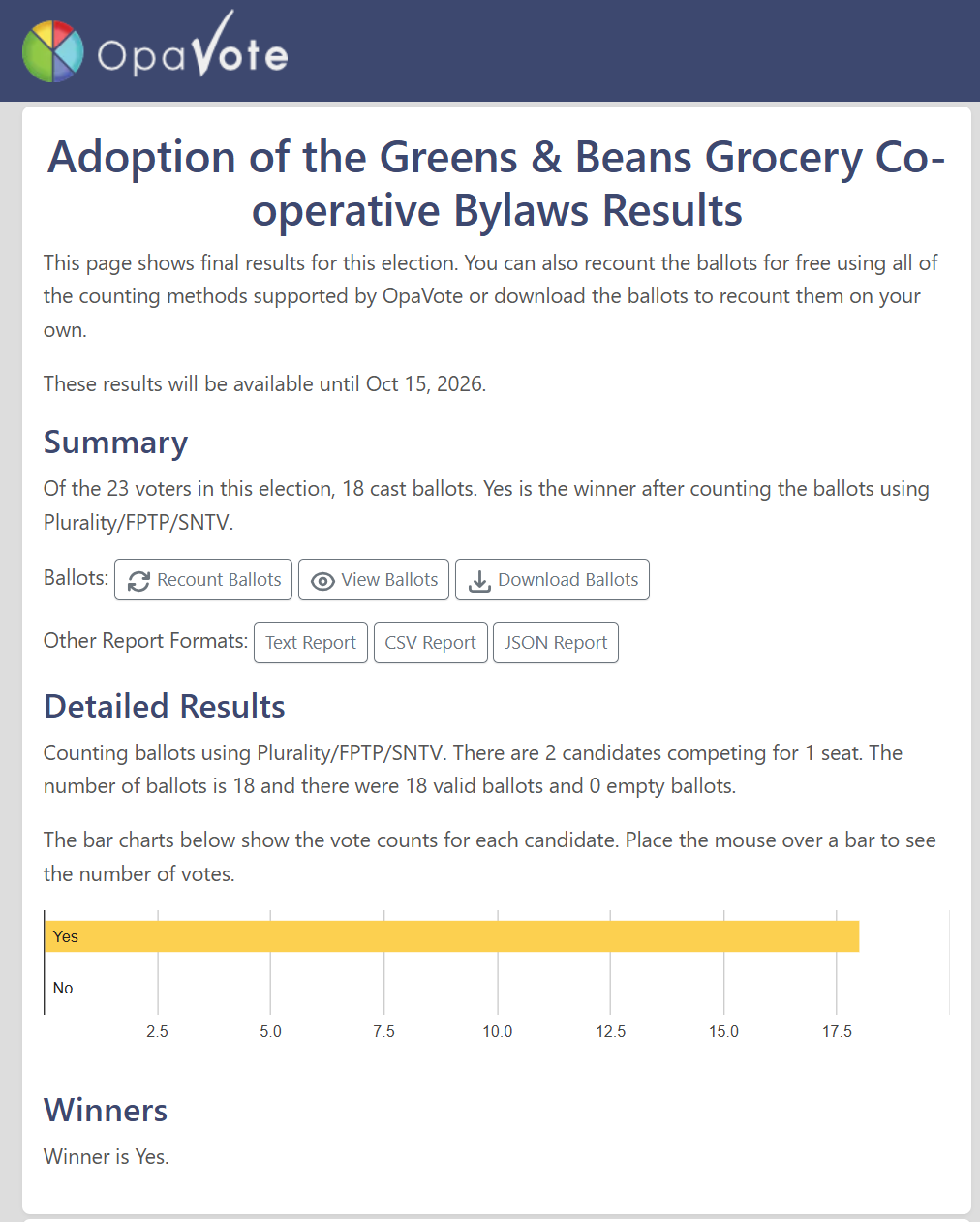
- Adoption of the Greens & Beans Grocery Co-operative Bylaws
- Criteria for accepting Customers
- Customer Shopping Policy
- Formalizing the proposal and voting process
- Guest Shopping Policy
- Markup Policy
- Quarterly Task Roundup Proposal
- Sign on to the Free DC Local Business Pledge
- Trial Period for New Members
- 11 Questions to Discuss Before You Talk to a Lawyer
- Proposal - Amendment to Probationary Period for New Members
- Discussion on Incorporation
- Committee Structure
- Proposal - Meeting Operation
- Proposal - Expanding Coop Access
- Proposal - Task Management 7.29.25
- Proposal - Non-Member Shopping
- Proposal - Write Letter of Intent for 1420 N Street
Active Agreements
11 Questions for a Lawyer
Since the co-op is considering incorporating in some form, we have been talking to Beloved Community Incubator (BCI) for legal support with this. As a next step, they asked us to answer 11 questions.
This proposal is to get consensus and agreement on how we'll be answering these 11 questions. We've discussed these questions in a couple of meetings, and already had agreement in several of them.
- How do you want the coop to be managed? By an elected board, by the members themselves, by one or more managers?
- Relevant membership agreement.
- How will major decisions be made? Majority vote, super majority, consensus, modified consensus?
- Relevant governance proposal.
- What are some decisions that you think should be considered “major”? For example: Deciding when to buy more paper towels vs. deciding to convert your coop bakery into a coop bowling alley.
- The current list from the governance proposal is: "proposals that would increase costs to members, use the cooperative's funds, or make changes to the membership agreement."
- To ask lawyer: is what we have enough? Are there other major categories/principles we should consider.
- Do you want to have committees? What sort of committees might make sense?
- We do currently have committees (working groups):
- Will all workers be members? (i.e. will there be employees that never become members?)
- General agreement that paid employees should be members, but would need to be a different category of member (e.g., might not be required to contribute additions labor or pay dues). Would this pose any issues with labor laws? How would this impact which path we choose for legal incorporation?
- General agreement that paid employees should be members, but would need to be a different category of member (e.g., might not be required to contribute additions labor or pay dues). Would this pose any issues with labor laws? How would this impact which path we choose for legal incorporation?
- Will there be a probationary period before a worker can become a member? What is this period?
- Relevant proposal on probationary periods. Note that we've also discussed re-evaluating proposals regularly.
- Will all the workers have the legal right to work in the U.S.?
- We want anyone to be able to receive payment for if we decide to pay people to do work. Generally in favor of paying employees but want to be able to do so. We don't yet know if these workers will be employees or worker members.
- How do you intend to pay your members? Salaries? Commissions? Profit Distributions? Some combination of these?
- At the moment we don't intend to pay members, unless (as mentioned above) we hire employees (salaried but also an owner class?). Then they would be salaried. At the moment we don't think we'll be do profit distributions, preferring to re-invest all profit into the co-op.
- How will you decide whether to admit new members?
- Relevant membership agreement. They must also pass the probationary period.
- How will you decide whether to remove/expel members?
- Relevant membership agreement.
- Is it important to you to use the word “cooperative” in your name?
- No
The vote in this proposal is a simple Yes / No on accepting these answers and taking them to BCI to talk to a lawyer.
Results
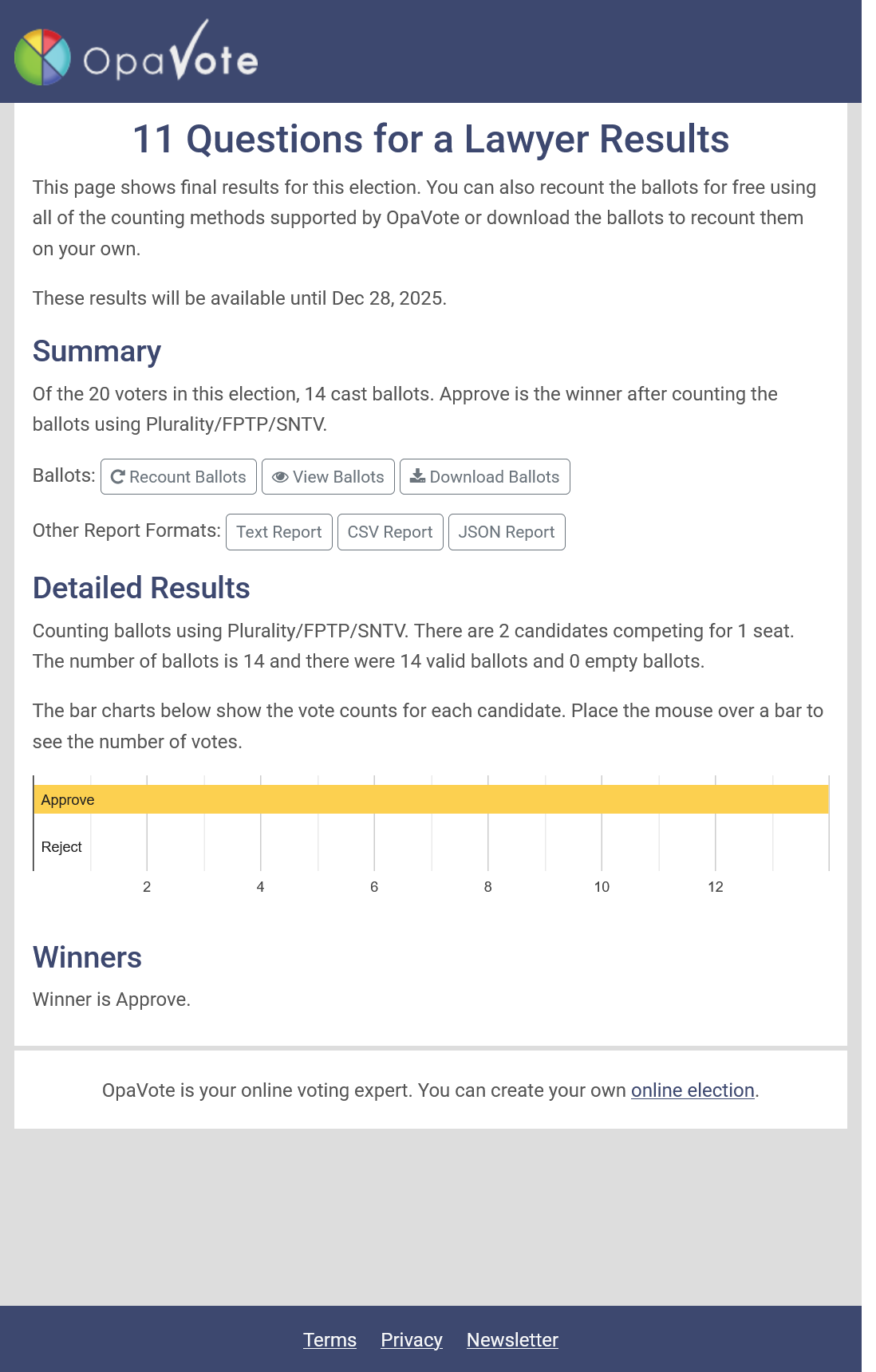
- The total number of eligible voting members was 20, so the number of votes needed for the proposal to be approved was 11.
- The number of ballots cast was 14 ballots (14 valid ballots, 0 empty ballots), all 14 of which voted to approve the proposal.
- Thus, the proposal passed.
Adoption of the Greens & Beans Grocery Co-operative Bylaws
Background
Since its inception, Greens & Beans has grown from an informal organizing group into a functioning community grocery co-operative. During that time, members have approved a number of individual agreements relating to governance, membership, voting, finances, operations, and organizational structure.
While these individual agreements have helped guide the Co-operative, they currently exist across multiple documents and proposals. This makes it difficult for both current and prospective members to understand the complete governance framework and creates the potential for inconsistencies or uncertainty as the Co-operative continues to grow.
Without a single governing document, the Co-operative faces several challenges:
- Governance decisions are spread across numerous proposals and meeting records
- Members may interpret approved policies differently or be unaware of existing decisions
- It is difficult to identify whether new proposals conflict with previously adopted agreements
- As membership grows, onboarding becomes more complicated because there is no single reference document explaining how the Co-operative is governed
- Legal incorporation and organizational continuity require a clear governance framework
Although operating policies can continue to evolve over time, the Co-operative also needs a stable set of governing principles that define its organizational structure, membership rights, decision-making processes, and allocation of authority.
Solution
To address this, the Administration Committee has consolidated the approved agreements into a single Bylaws document. The document incorporates standard organizational governance provisions, such as the purpose of the Co-operative, committee structure, dissolution, and the relationship between bylaws and operating policies, while preserving the intent of previously approved member decisions.
The proposed bylaws consolidate previously approved governance decisions into a single document while distinguishing between Bylaws, which establish the Co-operative's core governance framework and require approval by the membership to amend, and Operating Policies, which provide procedures and day-to-day guidance that may be developed and updated by the appropriate committee within the authority established by the bylaws.
If adopted, these bylaws will become the primary governing document of Greens & Beans and supersede any conflicting governance language contained in previously approved standalone proposals. Existing operational policies that are consistent with the bylaws will remain in effect until amended through the appropriate committee process.
Review Process
Members are encouraged to carefully review the draft bylaws before voting and discuss below (in the "Members discussion" section). The review period will remain open for two (2) weeks following distribution of this proposal.
During this time:
- Members may submit comments, questions, or suggested revisions.
- The Administration Committee will collect feedback and may recommend non-substantive edits for clarity or consistency.
- If significant issues are identified that materially affect the proposal, the committee may determine that a revised draft should be circulated before voting begins.
The purpose of this review period is to ensure members have sufficient opportunity to understand the proposed bylaws and identify any remaining concerns before a final vote.
Member discussion
In this section, members are invited to share their perspectives before the proposal moves to a vote. If you would like to contribute, please add your name and then statement. If possible, clearly state whether you are "In Favor", "In Favor With Reservations", or "Against" (and why) within your statement. This helps measure overall positions on the proposal. The goal of this section is to capture nuance and surface concerns early, in addition to conversations that happen at meetings and in online communication channels, so that members can make an informed decision.
- simon: in favor. Really grateful to folks who’ve helped shepherd this along. We’ll have to have a party.
- Jon: In favor. Thanks to the Admin committee! Super minor edits:
- For consistency, I suggest a find/replace "Co-operative" to "cooperative" since our incorporation paperwork has no dash in that word.
- Article IV, Section 3, i., "the Committee votes on the final Board" - I don't understand what this provision means. Do we mean the membership votes on the committee nominees to determine final composition of the Board?
- luigi: fixed the board approval piece to “Each committee nominates its representative through an internal selection process, and then the membership votes on the proposed slate of Board representatives, in accordance with Article V, Section 5.”
- luigi: edited to say ‘“Co-operative” and “Cooperative” may be used interchangeably for internal purposes; the legal entity, per the articles of incorporation, uses the non-hyphened version.’
Results
Criteria for accepting Customers
Proposal
The cooperative may begin accepting shopping by 'customers' when all of the following criteria are met:
-
- The cooperative has an active business license to operate in DC.
- The cooperative is legally allowed to sell products to 'customers' in DC.
- The cooperative has its own lease or mortgage in an independent or shared space outside of Luther Place Church, that individuals who are not members may access during set 'shopping hours' (to be determined by membership).
- A consensus of active members determines that labor needs are being met by the current membership.
Member discussion
In this section, members are invited to share their perspectives before the proposal moves to a vote. If you would like to contribute, please add your name and then statement. If possible, clearly state whether you are "In Favor", "In Favor With Reservations", or "Against" (and why) within your statement. This helps measure overall positions on the proposal. The goal of this section is to capture nuance and surface concerns early, in addition to conversations that happen at meetings and in online communication channels, so that members can make an informed decision.
- No comments were added.
Results
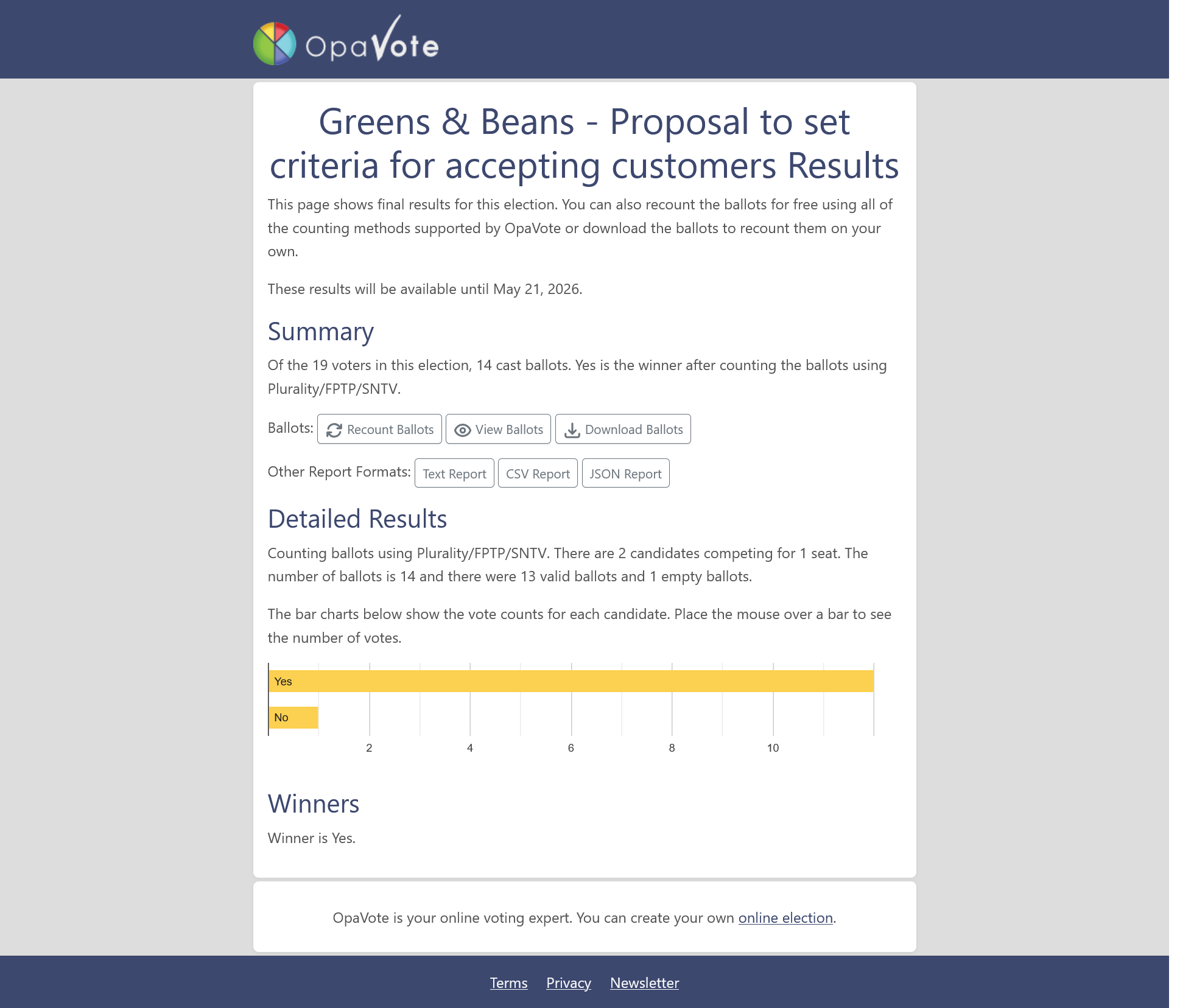
- The total number of eligible voting members was 19.
- The number of votes needed for the proposal to be approved was 10.
- The number of ballots cast was 14 ballots (13 valid, 1 empty).
- 12 voted Yes, and 1 voted No.
- Thus, the proposal passed.
Customer Shopping Policy
This proposal is to allow customers to be able to shop from the coop, while reserving voting privileges to members.
Background
Currently, only members who contribute labor and pay dues are allowed to shop with the coop.
Problem
By restricting shopping to members, we are screening out individuals who might be interested in shopping and joining our coop community at a lower engagement level than current members. Current practice also restricts our sales volume. If the volume of sales were to increase, we would potentially be able in the future to (1) negotiate for lower prices from Chicano Sol (and any other provider) and (2) provide cheaper and higher-quality goods to people in the community.
Solution
This proposal recommends that we open up access to our shelf stock and the Meso app to non-members, provided they are willing to pick their order up from Luther Place Church during our current shopping windows on Sunday and Wednesday (or other negotiated pickup location if necessary). Individuals who shop, do not contribute labor or pay monthly dues, and are not accompanied by a current member will be known as customers, in contrast to members or guests.
Customer Surcharge
The coop reserves the right to institute a percentage surcharge for orders by customers. This surcharge would be raised in the future if a need is assessed, but this proposal recommends a 10% surcharge to start.
Voting Rights
Only members would be able to vote on formal proposals and structural changes to the coop. Customers would be able to share feedback with members, and to respond to informational surveys that the coop may decide to issue.
Results
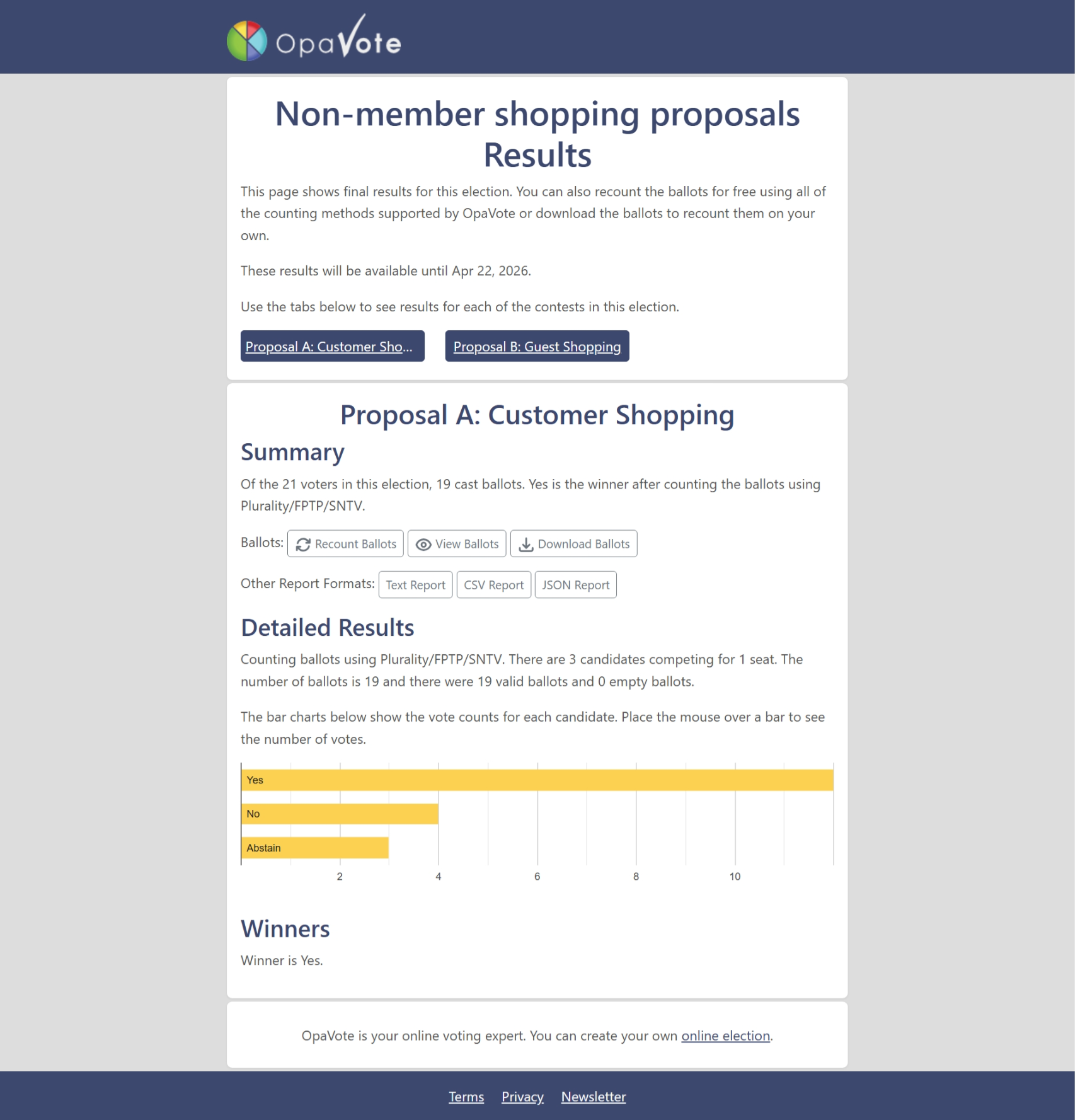
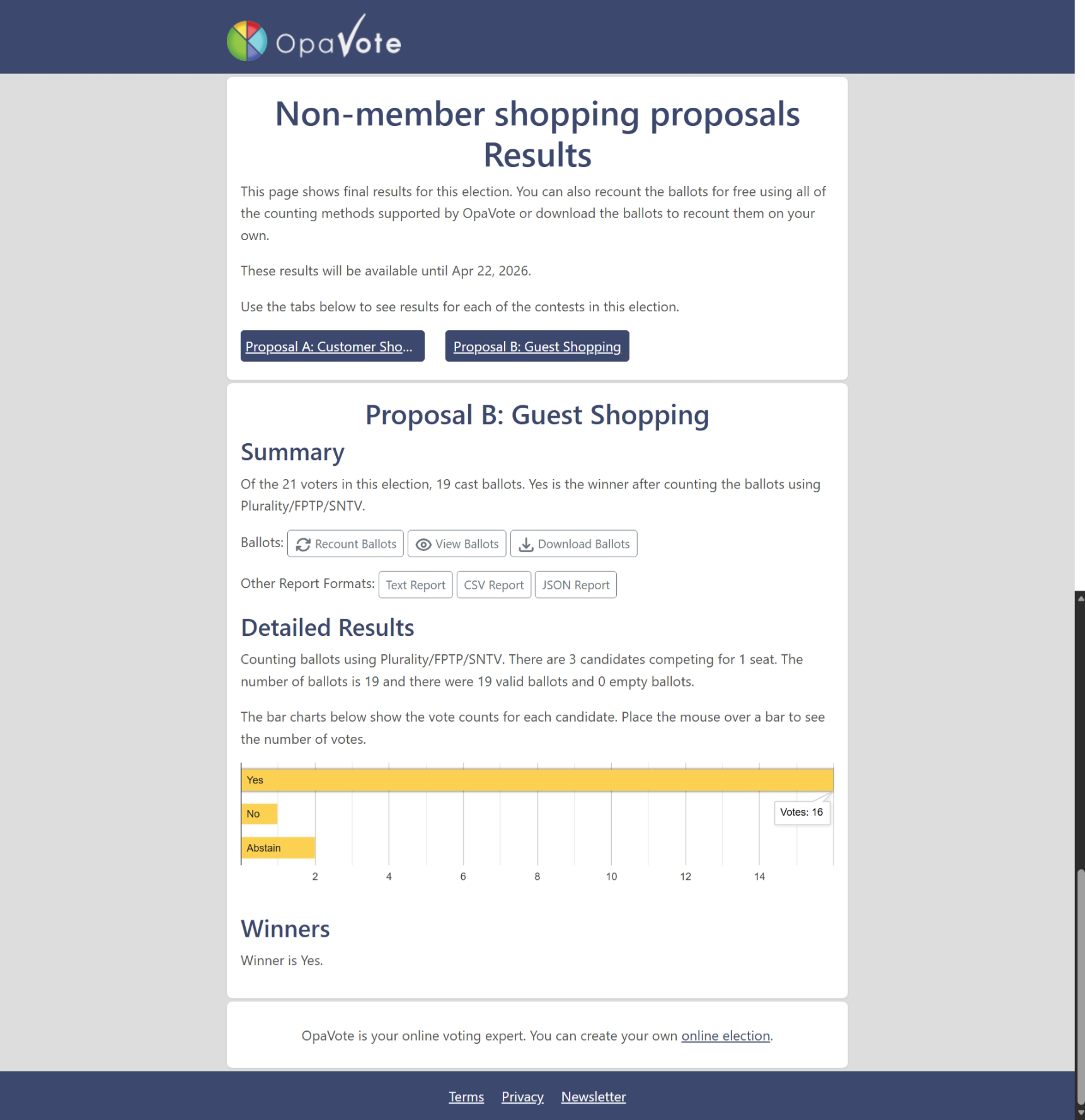
- The total number of eligible voting members was 21, so the number of votes needed for the proposal to be approved was 11.
- The number of ballots cast was 19 ballots (19 valid ballots, 0 empty ballots).
- 12 voted Yes, 4 voted No, and 4 abstained.
- Thus, the proposal passed.
Formalizing the proposal and voting process
Context / Problem
Our grocery cooperative values democratic governance and inclusive participation. However, our current voting process lacks standardization, which can lead to inconsistent implementation, unclear timelines, and reduced transparency. Specific challenges we have experienced or aim to avoid include:
-
Limited clarity on when proposals should be introduced and how they move forward to a vote
-
Insufficient time for members to review and reflect before being asked to vote
-
Uneven opportunities to propose alternative or amended options
-
Gaps in participation, especially from members who miss email links or meeting updates
-
Lack of a feedback loop to improve the voting process over time
To address these concerns, this proposal introduces a structured, predictable, and inclusive voting process to guide future decisions.
Summary
-
Proposals must be published on the wiki in advance of discussions.
-
Time will be dedicated at the Sunday meeting to discuss the proposal. In addition, discussions can (and should) occur via the other communication methods used by the cooperative (e.g., email listserv, WhatsApp).
-
Ranked choice voting is used by default.
-
OpaVote is used for secure, one-member-one-vote elections.
-
Ballots must go out within 24 hours or wait until the next meeting.
-
A minimum five-day voting window.
-
Final call for votes and results shared at the next Sunday meeting.
- Final results must meet a threshold of "quorum", defined as the winning option receiving a simple majority of the active members.
-
Feedback is collected after each vote for process improvement.
Detailed Standard Voting Process
1. Eligibility
- Before moving onto the next step, reflect on whether your proposal is solvable in a committee or working group.
- A non-exhaustive list of what should not be solvable within a committee or working group includes proposals that would increase costs to members, use the cooperative's funds, or make changes to the membership agreement.
2. Proposal Development
- Formally draft your proposal and get feedback on it by putting it on the agenda of an in-person Sunday meeting. It is recommended to get feedback from the cooperative beforehand, e.g., via the WhatsApp group, email listserv, or informally at a previous Sunday meeting (preferably a combination of these channels).
3. Proposal Refinement
- Based on feedback from the group, refine the proposal, especially if there are members flatly opposed to the proposal. Capture these perspectives and nuances into the proposal, which may appear as alternative options within the proposal.
4. Formal Submission
-
To be considered for a vote, proposals must be posted on the cooperative's wiki ahead of a Sunday meeting.
-
That Sunday meeting will include:
-
Presentation of the refined proposal
-
One final group discussion on pros and cons of the proposals and each option
-
One final time for adding amendments or alternatives
-
5. Ballot Creation
-
OpaVote is used for all ballots unless a different tool is specified.
-
Ballots go out the evening of the Sunday meeting (ideally) and no later than 24 hours after the end of the Sunday meeting at which the formal submission was made. If not possible, voting is postponed to the next meeting.
-
Each ballot includes all viable options using ranked choice voting.
6. Voting
-
Ballot is open for at least five (5) calendar days.
-
Final call for votes occurs at the next Sunday meeting.
-
Those who missed the email can vote live during the meeting.
7. Result Sharing and Feedback
-
OpaVote calculates results automatically.
-
Results are shared at the Sunday meeting immediately after voting closes.
- For the results to be valid/implemented, the winning option must receive a majority (i.e., more than 50%) of the member list in support.
- Example: The number of active members is 16, and 13 members vote. A majority of 16 is 9. However, there is not an option that received more than 8 votes due to empty ballots and/or enough members only ranking some but not all options.
- Note: In cases where the number of active members is odd, majority counts are the first whole number above the 50% fraction. For example, for an active membership of 21, 50% is 10.5, so 11 people voting in the affirmative is majority.
-
Brief discussion to:
-
Acknowledge results
-
Plan next steps
-
Collect feedback on process effectiveness
-
Implementation Notes
-
Member emails must be kept up to date for OpaVote.
-
Voting coordinators may be identified to ensure timely execution.
-
All final outcomes and voting summaries will be added to the wiki.
-
A feedback form or informal reflection will be used after each vote.
Results
- Of the 19 active voting members, 16 cast ballots (of which 0 were empty ballots).
- There were two options (Approve and Reject).
- All 16 ballots voted in favor to approve the proposal.

Guest Shopping Policy
This proposal is to allow guests to be able to shop from the coop, while reserving voting privileges to members.
Background
Currently, only members who contribute labor and pay dues are allowed to shop with the coop. If members bring a one-time or infrequent (twice a year) guest, they could shop through the member who brought them or we could establish a Guest Purchase policy with a Guest option on the buyer’s list of names.
Problem
By restricting shopping to members, we are screening out individuals who might be interested in shopping and joining our coop community at a lower engagement level than current members. Current practice also restricts our sales volume. If the volume of sales were to increase, we would potentially be able in the future to (1) negotiate for lower prices from Chicano Sol (and any other provider) and (2) provide cheaper and higher-quality goods to people in the community.
Solution
Individuals who come with a member (e.g., visiting family and friends) can purchase items as a guest. Prospective members who come to a social or onboarding event but have not become a dues and labor contributing member can purchase items as a guest. We define "guests" as people who have been invited to shop at the co-op by friends or through co-op organized events (eg. at an onboarding event or social). If co-op members feel that guests have been shopping too regularly, they should address the guest and ask them to become members and contribute labor.
Guest Surcharge
The coop reserves the right to institute a percentage surcharge for orders by guests. This surcharge would be raised in the future if a need is assessed, but this proposal recommends a 10% surcharge to start.
Voting Rights
Only members would be able to vote on formal proposals and structural changes to the coop. Guests would have no voting rights but could offer outside perspective and ideas on how to continue to improve processes or innovate to draw in more members and customers.
Results
- The total number of eligible voting members was 21, so the number of votes needed for the proposal to be approved was 11.
- The number of ballots cast was 19 ballots (19 valid ballots, 0 empty ballots).
- 16 voted Yes, 1 voted No, and 2 abstained.
- Thus, the proposal passed.
Markup Policy
Context / Problem
Since the co-op moved away from using Venmo for order payments and transitioned to an online payment processor (Stripe), we pay a fee to Stripe for every order we place.
Every time a member places an order, Stripe charges:
- 2.9% of the order amount
- Plus $0.30 for each transaction
Because of these fees, as we process more orders, the co-op spends more on processing costs.
- Each $20 order = ~$0.88 fee (about 4.4% of the order)
- Each $5 order = ~$0.45 fee (about 9% of the order)
Currently, members contribute monthly dues on a sliding scale from $5 to $20, which help cover operating costs such as inventory loss, gas for pickups, and saving for future rental space. However, dues are not tied to how much members order. As some members place larger or more frequent orders, processing fees increase without a direct link to individual usage. See Annex A.
These fees will increase with more members, orders, and volume and will limit our ability to save for the co-op's future needs. To address this, we are proposing several options for members to consider.
Options to vote on
Option 1: Add 5% markup on all orders
- Ensures processing fees are covered per order.
- Keeps monthly dues as-is.
- Estimated additional cost: $0.33 to $1 per order (e.g., $20 order = $1 extra).
- Generate negligible surplus to help with future needs beyond processing fees.
Option 2: Add processing fee amount as markup on all orders
- Ensures processing fees are covered per order, with more exact precision.
- Keeps monthly dues as-is.
- Estimated additional cost: $0.33 to $1 per order (e.g., $20 order = $1 extra).
- Does not build surplus for future needs like inventory loss or rental space.
Option 3: Use dues but increase minimum monthly amount
- Keeps individual order costs the same.
- Raises the minimum dues amount, particularly affecting members paying lowest option.
- May result in members who order less frequently contributing more to cover processing fees generated by higher-volume shoppers.
- Guarantees generating additional surplus to help with future needs beyond processing fees.
Option 4: Leave as-is (no markup, no dues increase)
- No immediate change for members.
- Processing fees continue to be absorbed by existing dues.
- Over time, less money remains for future savings as order volume grows.
Annex A. Monthly revenue and expense calculations

Results
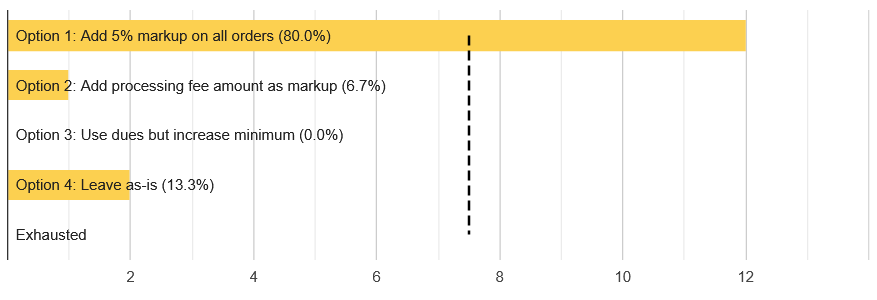
Option 1 (Add 5% markup on all orders) is the winner after counting 15 ballots using Instant Runoff Voting, with 80% of the votes in the first round. There were 15 valid ballots and 0 empty ballots.
Round 1 (count of first choices):
Quarterly Task Roundup Proposal
by Jon
Background
As previously raised by Hadley in her proposal for task assignment, we have struggled so far with tasks going unassigned and a lack of clarity on who is responsible to find replacements if members drop their assigned tasks for a given week.
Proposal
Quarterly Task Assignment
Beginning this September, once per quarter, the membership will use a regular Sunday meeting time (6 - 7:30 PM) to jointly volunteer for and distribute labor for the rest of that quarter. i.e. At a meeting in September, we will do task assignment for October, November, and December. This will be accomplished on our existing task spreadsheet, with the goal being to fill all open slots for the quarter. If the group wants to spice it up a bit, we can get a physical calendar/whiteboard/easel paper and mark who will take on which task slots as a group activity.
During this meeting, we will add members to existing Whatsapp channels relevant to the tasks they are assigned. If the group decides it makes sense to consolidate/delete/add new channels for groups to coordinate, we will do so. We will also review at this time whether certain tasks are necessary to assign for each week or whether a task can be deleted or completed on an as-needed basis.
If any tasks remain unassigned by 7:30 PM on the day of the review, we will send a message on the General channel the following day asking for volunteers to fill the remaining tasks for the quarter.
Individual Responsibility to Find Replacement
Once the calendar has been filled for the quarter, it is the responsibility of each member to follow through on their assigned tasks. If a member is not able to complete their previously assigned tasks for a given week, they must do the following as soon as they reasonably can, given their circumstances and ability:
- Remove their name from the slot in question on the task spreadsheet.
- Reach out to the relevant task group channel to find a replacement.
- If a replacement can't be found in the smaller group, reach out to the General channel.
Once a replacement is found, that member will add their name to the open slot on the task spreadsheet and becomes responsible for that slot.
Result
Approved by 8 votes out of a quorum of 15
Sign on to the Free DC Local Business Pledge
Proposal
This is a proposal for Greens & Beans to sign on to the Free DC Local Business Pledge.
The pledge, in full, is:
If you own a business and want to join this program, affirm the following pledge by completing the form at the bottom of this page:
This business stands for justice and dignity. We are committed to racial equity and protecting the rights of Black, Brown, immigrant, LGBTQ+, disabled, houseless, and working-class neighbors, as well as defending reproductive freedom and union rights.
This business is committed to protecting our community from harm. We oppose state violence, including deportations and over-policing, and support public efforts including DC’s public schools, public transportation, and housing affordability measures.
This business celebrates and strengthens DC. We are committed to uplifting the culture, history, and voices of DC residents, and protecting Home Rule, supporting democratic governance, and working toward DC statehood.
This business endorses Free DC’s campaign principles.
This business will not cooperate knowingly and directly with the Trump administration beyond what is legally required.
This business will deny consent to ICE or any law enforcement agency attempting to enter private areas of this business without a signed judicial warrant.
This business will review Know Your Rights for Businesses information provided by Free DC.
This business will display the Free DC decal proudly in your store window.
This business will remove the decal from your storefront if you fail to uphold all that you have pledged.
Business owners, affirm this pledge using the form below:
This proposal is for Greens & Beans to sign the pledge. We will describe our business as: "A membership -based grocery co-operative. People interested in bulk purchasing and shopping with us can fill in our interest form on our website: https://greensandbeansgrocery.com"
Member discussion
In this section, members are invited to share their perspectives before the proposal moves to a vote. If you would like to contribute, please add your name and then statement. If possible, clearly state whether you are "In Favor", "In Favor With Reservations", or "Against" (and why) within your statement. This helps measure overall positions on the proposal. The goal of this section is to capture nuance and surface concerns early, in addition to conversations that happen at meetings and in online communication channels, so that members can make an informed decision.
- Jon (in favor): I wholeheartedly agree with the points in the pledge and think it aligns with our values. As long as we’re clear in the little blurb (which we are) that it’s a membership-based co-op to set expectations appropriately for folks who find us through this pledge list, I think it’s a good step to show solidarity with Free DC and draw in a new avenue for potential members to find us.
Results
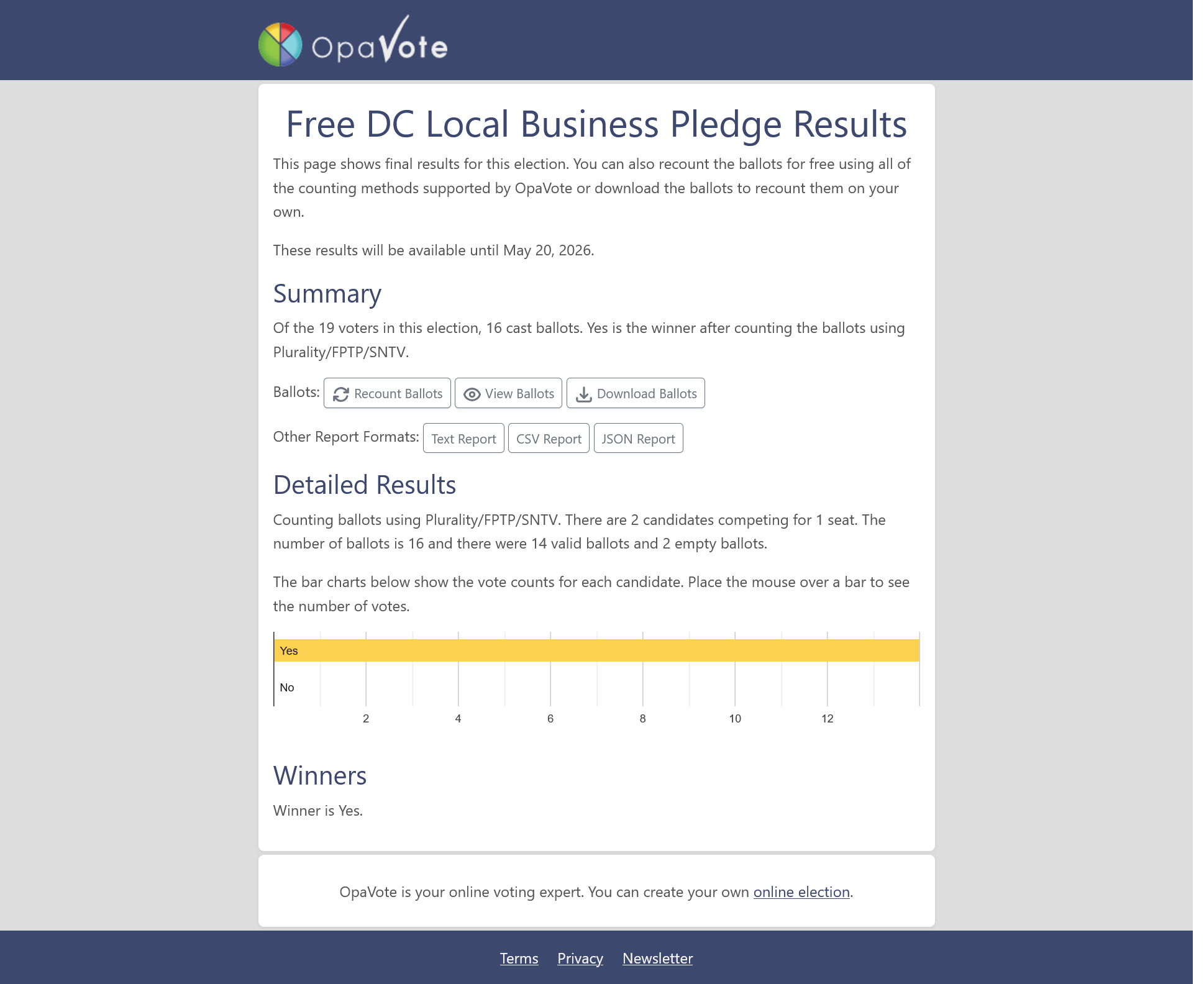
- The total number of eligible voting members was 19.
- The number of votes needed for the proposal to be approved was 10.
- The number of ballots cast was 16 ballots (14 valid, 2 empty).
- 14 voted Yes, and 0 voted No.
- Thus, the proposal passed.
Trial Period for New Members
As Greens & Beans continues to grow, we should ensure that new members demonstrate consistent interest and engagement with the group before obtaining full membership rights. This will avoid situations where new members join and then stop paying dues or disengage from contributing time/labor shortly afterwards, while retaining their voting rights and store access for the six month grace period currently in place for permanent members in arrears.
To address this, we will institute a three-month trial period for all new members.
The Membership Agreement will be updated as follows:
Membership Process
-
Fill in interest form
-
Pay dues
-
Attend an orientation
-
Fill in the membership agreement form
Once all of the above have been completed, you will be added as a trial member. After completing your responsibilities and remaining in good standing for three consecutive months (payment of monthly dues and order fees, contribution of time/labor, general appropriate conduct), you will become a permanent member. Otherwise, you will be removed as a member at the end of the trial period.
During the trial period, new members can:
- Contribute to discussions on chats and in person meetings
- Attend social events
- Submit agenda items and proposals
- Shop at the store
During the trial period, new members cannot:
- Access the store without a permanent member present
- Vote on proposals or be counted towards a quorum needed to pass a vote
- Elect members to serve as representatives on the Coordinating Committee
- Run for positions and serve as a representative on the Coordinating Committee
Results
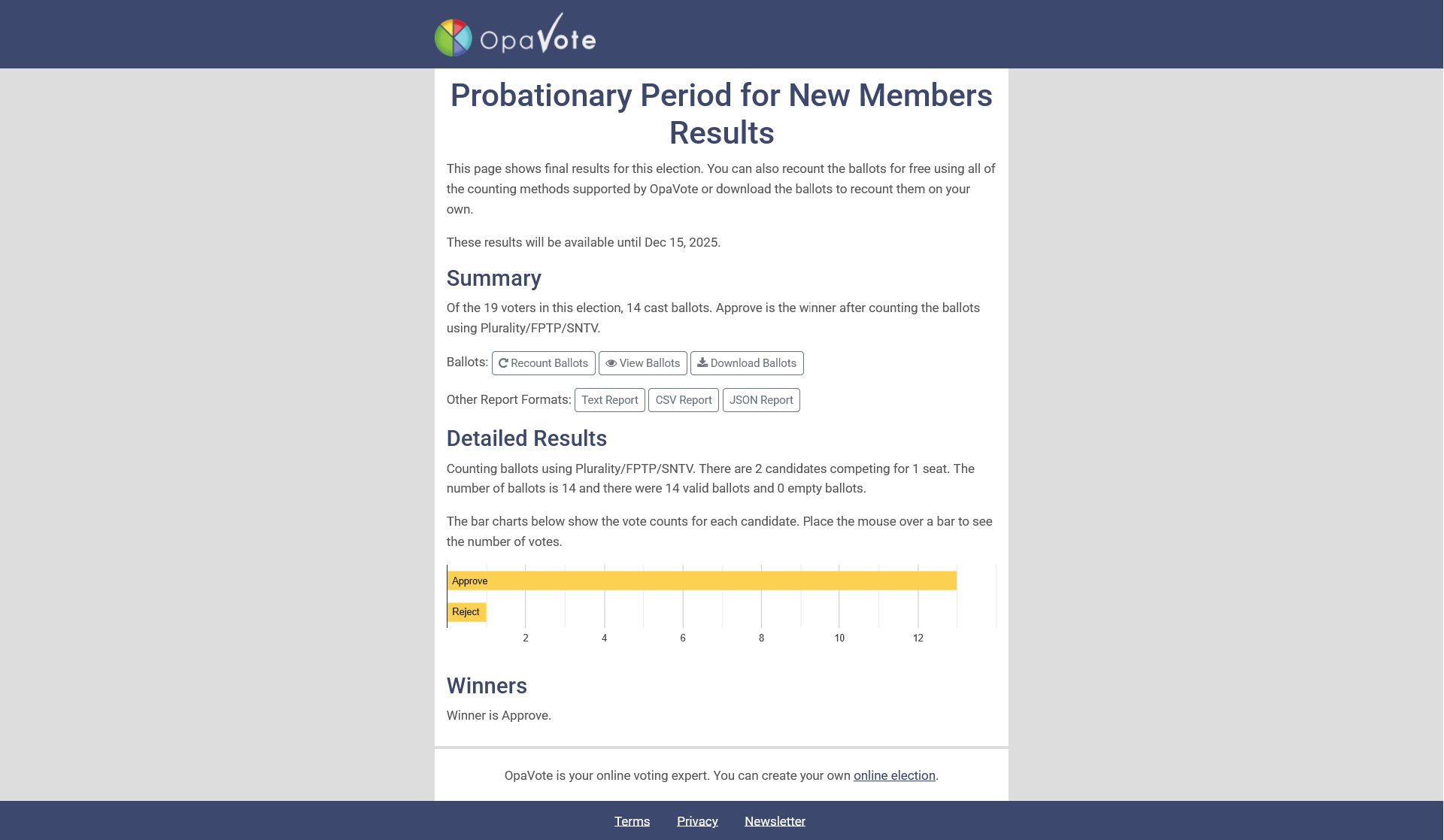
- The total number of eligible voting members was 19, so the number of votes needed for the proposal to be approved was 10.
- The number of ballots cast was 14 ballots (14 valid ballots, 0 empty ballots), 13 of which voted to approve the proposal. Thus, the proposal passed.
11 Questions to Discuss Before You Talk to a Lawyer
Please answer the following questions as a team to the best of your ability.
- How do you want the coop to be managed? By an elected board, by the members themselves, by one or more managers?
- Relevant membership agreement.
- How will major decisions be made? Majority vote, super majority, consensus, modified consensus?
- Relevant governance proposal.
- What are some decisions that you think should be considered “major”? For example: Deciding when to buy more paper towels vs. deciding to convert your coop bakery into a coop bowling alley.
- Think through this. The current list from the governance proposal is: "proposals that would increase costs to members, use the cooperative's funds, or make changes to the membership agreement."
- Do you want to have committees? What sort of committees might make sense?
- We do currently have committees (working groups):
- Will all workers be members? (i.e. will there be employees that never become members?)
- Think through this. It seems like a good idea to think through if we have "consumer members" vs "staff members" if we ever hire staff.
- Will there be a probationary period before a worker can become a member? What is this period?
- Relevant membership agreement. Think through this
- Will all the workers have the legal right to work in the U.S.?
- The question here is whether someone will be a W2 employee, or an LLC owner. Owners can get paid as non-U.S. citizens, but they can't receive a W-2 wage (I think--Simon).
- How do you intend to pay your members? Salaries? Commissions? Profit Distributions? Some combination of these?
- What happens with profits at the end of the year? Do we do a distribution to all members? Is it based on hours worked or just a flat fee? Or money spent in the co-op? Or do we not distribute them, and instead invest them in the co-op? This does have implications for example if we incorporate as an LLC, where profits get split between legal owners, and you have to file them on your taxes.
- How will you decide whether to admit new members?
- Relevant membership agreement.
- How will you decide whether to remove/expel members?
- Relevant membership agreement.
- Is it important to you to use the word “cooperative” in your name?
- Some states don't allow this, or require that you have a specific structure to be able to call yourself a co-op.
Proposal - Amendment to Probationary Period for New Members
As Greens & Beans continues to evolve, so do our policies and procedures. The current policy on the Probationary Period for New Members outlines a 3-month probationary period for new members, during which they have limited store access, voting, and representation rights. In response to recent discussions on new member onboarding, the following amendment is proposed to the policy to reflect current realities for new members:
The Membership Agreement and Probationary Period for New Members will be updated as follows:
- Update policy title to "Trial Period for New Members" to clarify policy intention and soften language
- Update probationary period to one month to expedite new member onboarding process and simplify tracking
Discussion on Incorporation
Greens & Beans has been considering legal incorporation this year to ensure legal operations, reduce member liability, and facilitate financials. Over the past two months, the Governance team has met with lawyers, including the Community Development Law Clinic at UDC and Gilmore Khandhar, LLC, to gather information and legal advice to support this decision.
The Governance team is recommending that Greens & Beans legally incorporate as a 501(c)(4), or social welfare organization. The following factors contributed to the recommendation:
- Without legal incorporation, the co-op's Treasurer is personally liable for the co-op's finances. Becoming a legal entity will provide liability protections and allow for an EIN to open an independent bank account. It is a priority to become legally incorporated as soon as possible.
- In the 11 Questions for a Lawyer, which was approved at the end of last year, members decided against profit distributions, "preferring to re-invest all profits into the co-op". General Cooperative Associations (GCAs) and Limited Cooperative Associations (LCAs) both characterize members as owners, who are entitled to equity in the business and often receive profit distributions as compensation. Nonprofit organizations (501(c)s) prohibit membership equity and limit profit distributions.
- All legal entities will require some iteration of a managing group (Board, managers, directors, etc.) that the members vote to elect. LCAs and GCAs have some specific requirements for a Board. Nonprofit organizations allow for more flexibility in the structure of the managing group.
- The purpose of Greens & Beans is to create a more just, resilient, and inclusive food economy for all. The lawyers we talked to were not confident that the co-op would qualify as a charitable, religious, or educational organization, which would be required for incorporating as a 501(c)(3). 501(c)(4) organizations, on the other hand, further the common good and general welfare of the community, which is more aligned with the co-op's purpose.
Committee Structure
Background
Greens & Beans has implied committees based on WhatsApp group chats. Decision-making is split between committees and the general group, with the specific group chats deciding whether a decision should be made by the group as a whole.
Problem
These committees are not comprehensive and do not facilitate necessary coordination between functions. The current committees/teams are as follows:
- General
- Products
- Governance
- Finance
- Coordinating
- Onboarding
In addition, there is a "Business Plan" chat that is not tied to any committee, but is still a relevant part of coop planning and execution.
Solution
We plan to reorganize into the following new committees and associated responsibilities:
| Committee | Responsibilities |
| Products | Products for sale; managing inventory; ensuring adequate supply; managing vendor relations |
| Internal Member Engagement | Members; onboarding; calendar; meeting planning; meeting notes; events (e.g., potluck socials) |
| External Community Engagement |
Relationships with other organizations; tabling/outreach; newsletters; socials; wheat pasting |
| Facilities | Back-of-house (physical space); front-of-house (schedule management of the space) |
| Administration | Legal; finance; coop rules |
WhatsApp groups will be renamed and combined, as needed, to fit these decisions.
Committees were designed to facilitate communication on relevant decisions; for any decision that needs to be made, we wanted there to be minimal cross-committee communication.
Decision Making
All decisions under the purview of a committee will be made solely by the committee. See the Formalizing the proposal and voting process agreement for details on decisions that are outside the scope of committees.
Committee Leadership
Each committee will elect, through whatever means they decide, two committee leads or points of contact who will serve on the Board.
The Board, once decided, will create and maintain a separate chat for their coordination, but are not recognized as a standing committee.
The Board of Representatives is responsible for:
- coordinating across committees to promote alignment of activities and priorities;
- serving as the primary forum for resolving cross-committee conflicts; and
- supporting communication and information-sharing among committees
Proposal - Meeting Operation
Proposal 1
By Ari
Meeting Time
Meetings are on Sundays 6:15-7:15pm. At 7:15pm, the meeting stops and all unfinished agenda items are added to the next meeting's.
Meeting Agenda
The meeting agenda is drafted as a bulleted list on its own page, titled by the date (e.g. "2025-06-22"), within the "Meetings" chapter. Each agenda item will be marked with either "vote" or "info".
Meeting Notes
Meeting notes will be updated on the same wiki page that has the agenda. Under each vote item, an entry will be added saying what the vote was for and what the result was. Under each info item, an entry will be added very briefly describing what the update was about.
"Vote" Items
If an item is marked "vote", then after no more than 10 minutes of discussion, we take a majority-rules vote.
"Info" Items
If an item is marked "info", then we have up to 5 minutes of discussion, after which we move on to the next item on the agenda. Further discussion can be had elsewhere outside of the meeting.
Proposal 2
By Hadley
Decision Making
Empower committees to make majority of decisions
- Expand group/committee membership to agreed upon min number of members for fair decision making
- Develop guidelines for discussion/decisions made at committee vs general meeting level
- Develop process for documenting/communicating decisions made at the committee vs general meeting level
Meeting Structure
Continue to hold open hours on Sundays with less expectation to attend regularly and with less of the time dedicated to structured discussion/meeting
Proposal - Expanding Coop Access
This proposal is to allow non-members to be able to shop from the coop, while reserving voting privileges to dues-paying members.
Simon - Overall thoughts: I think this would be cool if it existed but I don't really see why this needs to be a co-op project and it feels like it could happily live along the co-op work on its own with potentially the co-op as one of the clients (in the same role as the buildings) as outlined below! I think if there's energy to do this people should do it, but I'm not sure it makes sense to do "as Greens & Beans". Generally I'm wary of building in a "we must grow to succeed" mentality, especially because it sounds like to do this we need to turn over 10s of thousands of dollars in produce. On that note I think this focuses maybe too much on the produce side of things, which isn't the full extent of what we do.
Final thought: I think parts of this should be broken into separate proposals rather than a "all or nothing" thing. To me I think the customers vs members thing is entirely separate from setting up a bike messenger driven produce delivery project.
Luigi - I also think this can be separate proposals but, if we want, we can leave as one proposal with multiple items to vote on. Opavote allows that, and I think that is more efficient since the background and problem are the same across proposal items.
Jon - Let's split the proposals. The creation of a "customer" category sounds like something we're all more or less aligned on doing in the short term and is simple enough. The other proposals to drive expansion with building deliveries etc. we definitely do not have consensus on right now and needs more discussion by the group. Not appropriate to bring to a binding vote yet IMO.
Background
The mission of the coop is to provide access to cheap, high-quality, local food to the residents of Ward 2. As a secondary benefit, the coop desires to provide a social environment for its members.
- Simon - This isn't our mission.
Problem
The size of the active membership is about 5-10 per week,
- Luigi - Do we mean 5-10 people purchasing produce each week? Or people attending the weekly meeting? We have more active members overall, so I'm trying to understand what we're referencing here.
and our weekly purchases from the farmers market are an average of $68.35. While these purchases help the regular members of the coop, they come with two problems:
- we are failing to meet our mission of providing food to people, and
- Simon - This isn't the full extent of our mission, so it feels a little weird to use it in this way. The mission leads with community driven, which I think is an important thing to keep in mind when considering this kind of growth. The way this is used here makes it sound like if we don't provide food to everyone, we're failing, which obviously feels absurd.
- Luigi - Agreed. I wouldn't say we are feeling to meet our mission. If anything, I think we have been meeting the mission, e.g., I can personally that I have benefitted from cheaper food and household items because of this group (and I think others have too). So I would remove or reword.
- the farmers are less interested in working with us and giving us discounts because we are failing to bring business to them.
- Simon - want to flag that a number of us raised this as a concern when we started this relationship with the farmers, that we couldn't do large quantities of produce purchasing, and that we didn't want to jeopardize any relationships with farmers on the road to growing and pretending we can commit to more than we can. I'm worried that this is being used to create a sense of urgency. If only a small part of of our members are buying things through Meso and from the farmers market, we should consider that maybe it's actually not as high of a need as we might think? I think a large part of that average is coming from our egg purchases rather than produce, and maybe we need to re-evaluate how we buy those if it's not satisfying to the farmer?
- Luigi - Do we know this for a fact? Like have farmers directly told us this and refused to work with us because of our size? If not, I would remove. I understand the sentiment is that we might be limited in receiving discounts due to our size, but that is not what is written. Suggest rewording or removing.
- Hadley- agreed. Would be good to understand whether Chicano sol has concerns about the order amounts in terms of continuing to work with us (I’ve heard different things from different people at different times about this)
The major hurdles involved in shopping are the geographic restriction (Ward 2),
- Luigi - We don't restrict membership to Ward 2.
the requirement for a separate payment of monthly dues, and the requirement for a pickup at a specific time and place behind a locked door.
Sale History
| Date | Sale |
| 11/16 | $0.00 |
| 11/9 | $12.05 |
| 11/2 | $137.10 |
| 10/26 | $20.80 |
| 10/19 | $134.90 |
| 10/12 | $33.10 |
| 10/5 | $110.60 |
| 9/28 | $0.00 |
| 9/21 | $132.10 |
| 9/14 | $21.40 |
| 9/7 | $55.85 |
| 8/31 | $161.55 |
| 8/24 | $29.00 |
| 8/17 | $14.05 |
| 8/10 | $137.90 |
| 8/3 | $90.50 |
| 7/27 | $66.30 |
| 7/20 | $86.49 |
| 7/13 | $7.00 |
| 7/6 | $0.00 |
| 6/29 | $84.50 |
| 6/22 | $71.00 |
| 6/15 | $98.40 |
| 6/8 | $76.30 |
| 6/1 | $102.50 |
| 5/25 | $93.60 |
Solution
To increase shopping, this proposal recommends that we open up access to the Meso app to any resident in DC, provided they are willing to pick their order up from the Lutheran church on Sunday (or other negotiated pickup location). Those who shop through us and do not pay dues will be known as customers, in contrast to dues-paying members.
- Luigi - Members can also be customers, so I don't think this is the proper way to delienate. We later say "non-member customers", so perhaps "member customers" and "non-member customers" might be the way forward.
- Jon - Member vs. customer is fine in my opinion - it's clear enough that members can also shop, we don't need to overcomplicate the concept. Important to note that Members are expected to contribute labor and dues are part but not all that's expected of folks.
Geographic Restriction
In order to alleviate the first hurdle of geographic restriction, this proposal recommends lifting the geographic restriction entirely and allowing anyone to shop through the coop.
- Simon - I don't think we have, or have ever had, a geographic restriction? As far as I'm aware anyone can come and shop. e.g. Mia and David don't live in Ward 2. Recognize that maybe the confusion here comes from having ward2coop.com as our domain, but that was an SEO decision made by a member who's not here anymore. We also own greensandbeansgrocery.com if we think that will help.
- Luigi - Agreed. This section should be removed. And I agree with changing the wiki website URL (and in general ceasing use of "Ward 2 Grocery Coop" and similar wording moving forward).
Monthly Dues
Instead of dues, the coop reserves the right to institute a percentage surcharge on each order for non-member customers. This surcharge would be raised in the future if a need is assessed, but based on the greater need for increased order volume than for increased coop funds, this proposal recommends a 0% surcharge to start.
Only dues-paying members would be able to vote at coop meetings.
Customers would be able to vote in non-binding surveys that the coop may decide to issue.
- Simon - why start with a 0% surcharge? Maybe I'm misunderstanding but why should non-members get a cheaper price then members, especially if they're not paying dues as well? Why would anyone become a member under this proposal? Also, as we discussed, paying dues isn't the only requirement towards voting, it's also labor. Might be something good to clarify in a different proposal.
- Luigi - Is the idea that we stop having dues, members get access to non-surcharged items, and non-members pay a surcharge to shop here?
- Jon - It's confusing to me as well to start with 0%. I would say let's start with a reasonable but meaningful markup like 5-10% for customers and we can always adjust if that proves too big a barrier for people.
Pickup
Currently, the coop requires groceries to be picked up at the 6pm Sunday meeting.
- Luigi - I think grocery pickup and shopping can be done also on Wednesdays, right?
- Hadley- groceries can technically be picked up any time! We just recommend by Wed to make sure they don’t get taken/removed by other groups
This proposal recommends working with individual apartment complexes to bring in their residents as customers and to deliver their groceries to a single location.
The orders would be split out by customer and delivered as a group to the location, coordinating through an order captain. The order captain's role is to facilitate the receipt of the orders and the dissemination to the residents; the delivery agent is not expected to hold onto orders if they are unable to get ahold of the order captain.
The selection of which apartment complexes we choose to support is an opportunity for the us to build relationships with those groups and ensure that we aren't taking on more customers than we can support.
While having coop members perform the delivery is an appealing way to keep costs low and maintain relationships with the order captain, food delivery is a job that is fraught with hazard and requires serious capital assets for each volunteer (cargo bike, car, van). Based on the experience of W2MA's grocery deliveries — and how they are shifting to pickup due to the difficulty of volunteer-based delivery — this proposal recommends pursuing a way to pay bike couriers (who already have the capital assets of cargo bikes) to do the deliveries. This proposal also recommends instituting a delivery fee to fund deliveries to apartment complexes.
- Simon - I think this would be very cool if it existed! I think it makes more sense to pilot this successfully for several months with a couple of buildings before bringing it into how we Do Things As a Co-op. I don't know that a proposal is needed to start that pilot project and I'm not sure why it would benefit the pilot project for it to be part of this co-op? Honestly it feels like if there's legs for this you're constraining yourself by having it be part of a slow moving co-op that primarily moves on a consensus basis. Like, why not just start trying to do this? Why do you need The Co-op to do this?
- "Based on the experience of W2MA's grocery deliveries — and how they are shifting to pickup due to the difficulty of volunteer-based delivery" I think this is a misunderstanding with what was going wrong with the W2MA delivery process. We had enough volunteers to do the deliveries, but at the time of delivery not everyone who had ordered was there to pick up, causing food waste. I don't see how paying couriers will fix this. This feels like it's better fixed by offloading the problem on the building captain from earlier in this proposal.
- Luigi - In general, I love the idea of working with apartment complexes. I'm not yet a fan of the following idea (order captain, paying bike couriers, etc), but I'd love to talk about the idea and see how we can pilot institutionalizing order delivery or pickup with buildings. Si and I live in the same building, and he's already been doing this (at least for eggs) so we can definitely learn from that, expand offerings, and go from there.
- Hadley- agreed! I’m also interested in working with apartment complexes (but more on a pilot basis to start and only if we determine we have the bandwidth for it). I’m also not quite sold on the bike messengers at this point. I’d suggest we try it out with 1-2 buildings with our members and then determine if we need the bike messengers
Conclusion
We are failing to meet our mission of feeding people. By allowing non-members to shop at the coop and take advantage of our budding relationships with the farmers at the market, we'll be able to feed more people, both in Ward 2 and beyond.
This proposal recommends:
- Eliminating geographic restrictions for members and customers
- Adding a surcharge to non-member customer orders, starting at 0%
- Working with apartment complexes to bring their residents in as customers and to add their complex as delivery location
- Pursuing a way to pay bike couriers to do the grocery deliveries
Proposal - Task Management 7.29.25
By Hadley
Developed 7/29/25; Discussed 8/3/25
Current State
Members sign up for tasks monthly in this spreadsheet, which calculates their total labor contributed over time. This approach allows members to experience a variety of tasks, but we often have trouble guaranteeing tasks are filled and managing participation.
Proposed Future State
Members sign up for task(s) that they will be consistently responsible for (e.g., one member is always the notetaker during meetings). Members can coordinate with others to fill in if they are unable to complete their task in a given week. This approach guarantees that all tasks are filled and simplifies roles and responsibilities. There is still an opportunity for task variety by picking up task shifts for others, as needed.
Implementation
- Create separate static tab on task spreadsheet
- Send out a call for sign ups. Suggest giving members 2 weeks to sign up for tasks
- If there are tasks that still need support after 2 weeks, initiate a discussion about task priorities and must-have activities (e.g., if there are no volunteers for specific tasks, is it an activity that we need to continue at this time)
- Opportunity to revisit approach at a later date if there are challenges or concerns
Proposal - Non-Member Shopping
This proposal is to allow non-members to be able to shop from the coop, while reserving voting privileges to members.
Background
Currently, only members who contribute labor and pay dues are allowed to shop with the coop. If members bring a one-time or infrequent (twice a year) guest, they could shop through the member who brought them or we could establish a Guest Purchase policy with a Guest option on the buyer’s list of names.
Problem
By restricting shopping to members, we are screening out individuals who might be interested in shopping and joining our coop community at a lower engagement level than current members. Current practice also restricts our sales volume. If the volume of sales were to increase, we would potentially be able in the future to:
- Negotiate for lower prices from Chicano Sol (and any other provider)
- Provide cheaper and higher-quality goods to people in the community
Solution
This proposal recommends that we open up access to our shelf stock and the Meso app to non-members, provided they are willing to pick their order up from Luther Place Church during our current shopping windows on Sunday and Wednesday (or other negotiated pickup location if necessary). Individuals who shop and do not contribute labor or pay monthly dues will be known as customers, in contrast to members. Individuals who come with a member (whether visiting family and friends) could purchase items as a guest. Prospective members who come to an open house or onboarding event, but have not become a dues and labor member could purchase items as a guest. We would need to monitor guests and determine by what measure do we request them to become a member or customer to continue to shop.
Customer Surcharge
The coop reserves the right to institute a percentage surcharge for orders by customers. This surcharge would be raised in the future if a need is assessed, but this proposal recommends a 5% surcharge to start.
Voting Rights
Only members would be able to vote on formal proposals and structural changes to the coop.
Customers would be able to share feedback with members, and to respond to informational surveys that the coop may decide to issue.
Guests would have no voting rights but could offer outside prospective and ideas on how to continue to improve processes or innovate to draw in more members and customers.
Proposal - Write Letter of Intent for 1420 N Street
We're proposing that Greens & Beans write a Letter of Intent for showing their commitment to moving into the space of 1420 N Street.
Patchwork LLC is the entity established to facilitate the purchase of the space. Any members interested in helping shape that should reach out to Simon, Noel, or Erin S.
A business plan for the space can be viewed here. A numbers budget and projections can be seen here.
The letter of intent is outlined here but copied in entirety below. A letter like this will help Patchwork fundraise for the downpayment but does not commit ourselves in any legal form.
Greens & Beans Grocery Co-operative
Feb 3, 2026To: Patchwork Community LLC
Patchwork
[Potential Address: 1420 N Street NW, Washington, DC]Re: Letter of Intent – Expression of Interest for Use of Space
Dear Members of the Patchwork Community LLC,
This Letter of Intent expresses the sincere interest of Greens & Beans, a Grocery Co-operative, in securing one of the dedicated spaces within the proposed Patchwork community center.
Key Points of Interest:
- Space Use: We intend to use 400 sq ft of space for food storage, food access, and food distribution among our members. We are highly interested in a space that can receive orders while our members are not present. We are also highly interested in the potential for collaborative use of shared common areas. We hope that this space access will help us grow our membership.
Proposed Terms (Preliminary & Subject to Final Agreement):
Space: Space integrated within the communal space, with usage limited to grocery co-operative dues paying members, approximately 400 square feet, with necessary access to dish washing sinks, and space for fridges and freezers.
Term: We are interested in a standard one-year lease, with the option to renew.
Rent: We are prepared to discuss a monthly rent within the projected range outlined in Patchwork materials, understanding this supports the collective model, with an additional understanding that we might not be able to afford the full rent until our membership matches the space available.
Target Timeframe: We aim to commence occupancy upon the successful launch of Patchwork's physical location.
This LOI is intended to outline our genuine interest and begin a formal dialogue. It is not a legally binding commitment to lease, nor is it a guarantee of space availability on the part of Patchwork. Any final agreement will be subject to, and embodied in, a formal Lease Agreement to be negotiated and executed by both parties, contingent upon the successful acquisition and build-out of the Patchwork facility.
We are eager to explore this opportunity further and believe our presence could contribute positively to the vibrant ecosystem you are building. We are available to meet at your convenience to discuss next steps.
Sincerely,
[Your Name]
On behalf of, Greens & Beans Grocery Co-operative[Contact Email]
[Contact Phone Number]